When someone sends you “opt” in a text message, you might wonder whether it is slang, an abbreviation, or simply a shortened English word. The meaning of OPT depends on how it appears in the conversation. Unlike widely recognized texting abbreviations such as LOL or BTW, OPT does not have one universally established meaning in casual messaging.
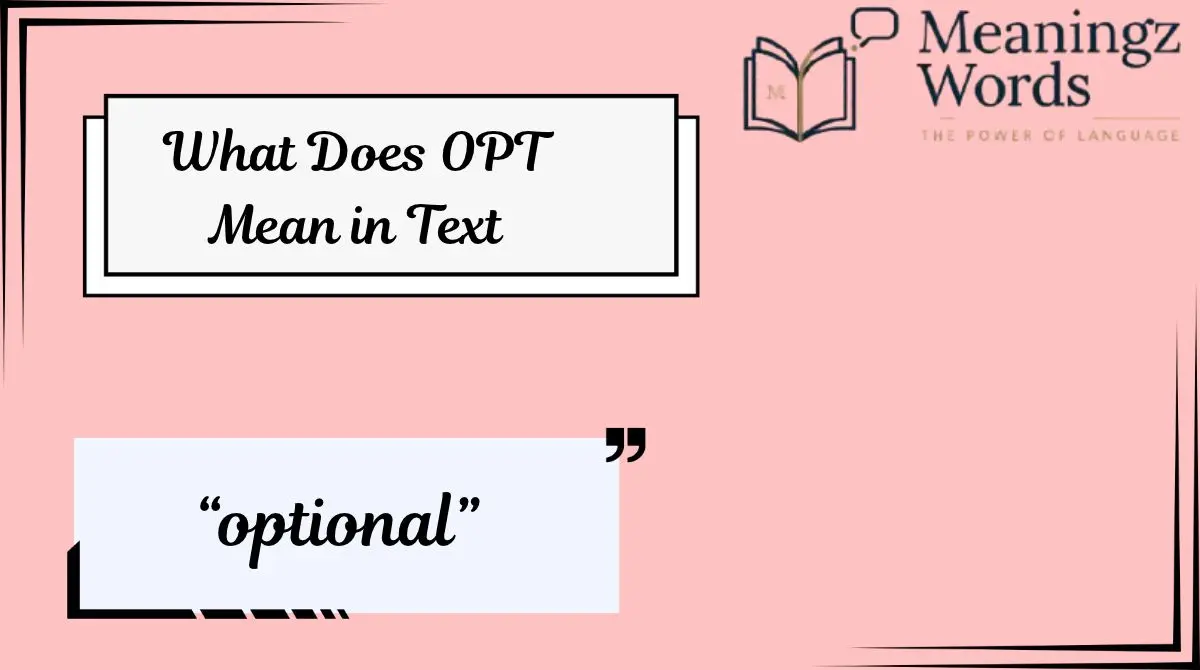
Most commonly, opt is the standard English verb meaning to choose or make a decision. It can also appear as shorthand for “optional” or in expressions such as “opt in” and “opt out.”
In this guide, you will learn what does opt mean in text, how people use it in everyday conversations, whether capitalization changes its meaning, and how to respond naturally when someone sends it.
Quick Answer: What Does OPT Mean in Text?
OPT usually means choose or select something when used as an ordinary English word in texting. It can also refer to something optional, depending on the sentence. For example, “You can opt for the blue one” means you can choose the blue one. OPT is not a universally recognized texting abbreviation.
What Does OPT Mean in Text?
The word “opt” means to choose one possibility from several available options. It is commonly used when someone is making a decision or expressing a preference.
For example:
- “I will opt for the cheaper one.”
- “You can opt out if you don’t want to participate.”
- “She decided to opt for online classes.”
In text conversations, people generally use opt in the same way they use it in everyday English. It is not necessarily internet slang or a special social media expression.
What Is the Full Form of OPT?
OPT does not have one fixed full form in everyday texting.
Depending on the situation, it may be used as:
- Opt: To choose or select something.
- Optional: Something that is not compulsory.
- Opt in: To agree to participate or receive something.
- Opt out: To choose not to participate or receive something.
It is important not to assume that every appearance of OPT represents an abbreviation. Sometimes it is simply the ordinary English word written in capital letters.
How Do You Pronounce OPT?
OPT is pronounced like the word “opt,” which rhymes with words such as “adopt” (the final syllable) and “stopped.”
Its pronunciation is approximately /ɒpt/ in British English and /ɑːpt/ in many American English accents.
What Is the Tone of OPT?
The tone depends on the surrounding message.
It can sound:
- Neutral: When someone is discussing a choice.
- Friendly: When suggesting an option to a friend.
- Professional: When discussing decisions or preferences.
- Informal: When used in a casual conversation.
- Direct: When someone asks another person to make a decision.
The word itself is not romantic, offensive, rude, or sarcastic. However, the complete sentence can communicate different emotions.
For example:
“I think you should opt for the first one.”
This sounds like ordinary advice.
“You can opt out if you don’t care.”
Depending on the relationship and conversation, this might sound slightly dismissive.
Origin and Background of OPT
The word “opt” is not a recently invented texting abbreviation. It comes from the Latin word optare, meaning to choose or wish for something.
It entered English through French and became an established verb used to describe making a choice between different possibilities.
Over time, expressions such as “opt in” and “opt out” became common in everyday language, business communication, technology, and online services.
With the growth of digital communication, people started using these expressions in messages about subscriptions, privacy settings, group activities, notifications, and personal decisions.
There is no reliable reason to attribute the word’s origin to a particular social media platform or texting trend. It existed in English long before modern messaging applications became popular.
How OPT Is Used in Text Conversations
The meaning of opt becomes easier to understand when you look at the complete sentence.
People may use it when discussing plans, choosing products, making arrangements, or deciding whether to participate in something.
Here are some realistic situations.
1. Choosing Between Different Options
Someone might use opt when recommending or discussing a particular choice.
Example:
Friend A: Which dress should I buy?
Friend B: Opt for the black one. It looks better.
Here, opt means choose. The sender is recommending the black dress.
2. Discussing Plans With Friends
The word can also appear when people are deciding what to do.
Example:
Person A: Are we going by bus or car?
Person B: Let’s opt for the bus. It’s cheaper.
The second person prefers traveling by bus.
3. Talking About Participation
People often use “opt in” when they want to join an activity, program, or service.
Example:
Friend A: Are you joining the study group?
Friend B: Yes, I’ll opt in tonight.
This means the person intends to participate.
4. Politely Refusing Something
“Opt out” describes choosing not to participate.
Example:
Person A: Are you attending the event?
Person B: No, I’ll opt out this time.
The person has decided not to attend.
5. Making a Casual Recommendation
Opt can make a suggestion sound slightly more formal than simply saying “choose.”
Example:
Friend A: Should I take the morning class?
Friend B: I’d opt for the morning one. It’s easier to manage.
The sender is expressing a preference.
What Does OPT Mean on Different Platforms?
OPT does not have a completely different meaning on every social media platform. Its interpretation generally stays connected to choosing, selecting, or deciding whether to participate.
However, the situations in which people encounter the word can differ.
OPT on WhatsApp
On WhatsApp, someone might use opt while discussing plans, shopping, group activities, or personal preferences.
For example:
“Just opt for the first option.”
The sender means that the recipient should choose the first available option.
OPT on Snapchat
On Snapchat, the word may appear in casual conversations about plans, preferences, or decisions.
For example:
“I’m going to opt out tonight.”
This means the person has decided not to participate in an activity.
There is no universally established Snapchat-specific slang meaning for OPT.
OPT on Instagram
On Instagram, opt may appear in direct messages, comments, captions, or discussions about choices.
For example:
“You should opt for this outfit!”
Here, the sender is recommending an outfit.
It may also appear in discussions about optional features, promotions, or subscriptions.
OPT on TikTok
On TikTok, people may encounter opt in videos discussing choices, settings, participation, or online activities.
For example:
“Users can opt out of this feature.”
This means users can choose not to use or participate in the feature.
The word does not automatically indicate a TikTok trend or a special TikTok abbreviation.
OPT on Facebook
On Facebook, opt may appear in comments, Messenger conversations, group discussions, and posts.
For example:
“I’ll opt for the online meeting instead.”
The person prefers attending online rather than in person.
OPT on Discord
On Discord, people may use opt when discussing gaming sessions, server activities, roles, or group participation.
For example:
“You can opt into the tournament if you’re interested.”
This means interested members can choose to participate.
OPT on Dating Apps
On dating applications, opt may appear when people discuss preferences, plans, and personal boundaries.
For example:
“I’d opt for coffee instead of dinner for a first meeting.”
The sender is expressing a preference for a coffee date.
The word itself does not indicate romantic interest. The surrounding conversation provides that information.
What Does OPT Mean From a Girl or Guy?
The meaning of opt does not change depending on whether a girl or a guy sends it.
Both can use the word to express a preference, suggest an option, or explain a decision.
However, the relationship between the people and the surrounding conversation can influence the message’s tone.
When a Girl Uses OPT
If a girl sends:
“You should opt for the pink one.”
She is probably suggesting that you choose the pink option.
If she says:
“I’ll opt out tonight.”
She means she has decided not to participate.
Neither message automatically indicates romantic interest.
When a Guy Uses OPT
If a guy says:
“Opt for the earlier flight.”
He is recommending the earlier flight.
If he writes:
“I might opt out of the plan.”
He is considering not participating.
Again, the word itself does not communicate attraction or romantic feelings.
How to Understand the Sender’s Actual Intention
Pay attention to these clues:
- Relationship: Is the sender a friend, classmate, colleague, or romantic partner?
- Context: Are you discussing plans, shopping, activities, or preferences?
- Punctuation: Does the message sound like a suggestion, question, or statement?
- Emojis: A smiling emoji may make a recommendation feel friendlier.
- Previous messages: The conversation before the word often explains its purpose.
It is better to interpret the complete message instead of assigning a special meaning to OPT based on the sender’s gender.
Other Possible Meanings of OPT
Although opt usually refers to choosing something in ordinary English, OPT can have other meanings in specific contexts.
The following table explains some genuine uses.
| Meaning | Context | Example |
|---|---|---|
| Opt (choose) | Everyday conversations | “I’ll opt for the cheaper option.” |
| Optional | Instructions and informal shorthand | “The extra activity is OPT.” |
| Optional Practical Training | US international student immigration and employment context | “My OPT application is being processed.” |
| Opt in | Subscriptions, services, and participation | “You can opt in to notifications.” |
| Opt out | Privacy settings and participation | “I decided to opt out.” |
What Does OPT Mean in American Student Contexts?
In the United States, OPT can also stand for Optional Practical Training.
It is a type of temporary employment authorization associated with eligible F-1 international students. It allows qualifying students to gain practical work experience related to their field of study, subject to applicable immigration requirements.
For example:
“My university’s international student office helped me understand OPT.”
This meaning is relevant to education and immigration discussions, not ordinary casual texting.
Does OPT Mean Optional?
Sometimes people use OPT as an informal shortening of optional, particularly in notes, forms, instructions, or quick messages.
For example:
“Attendance: OPT”
The writer may mean attendance is optional.
However, this is not a universal texting definition. The surrounding sentence determines whether this interpretation makes sense.
Important: Do not confuse OPT with OTP or OP. They are different expressions.
- OPT: Choose or select; may have other context-specific meanings.
- OTP: One-Time Password or One True Pairing, depending on context.
- OP: Original Poster in online discussions, or Overpowered in gaming.
How to Respond to OPT in a Text Message
Your response should depend on what the sender is discussing.
If someone is recommending a choice, you can agree, disagree, or ask for clarification.
Here are some natural replies.
1. If You Agree With the Suggestion
“That’s a good idea!”
Example:
Friend: Opt for the blue dress.
You: That’s a good idea! I’ll get that one.
2. If You Want More Advice
“Which option do you think is better?”
This works when you are unsure what to choose.
3. If You Want to Keep It Casual
“Yeah, I think I’ll go with that.”
This is a natural response between friends.
4. If You Disagree Politely
“I was actually thinking about choosing the other one.”
You can express your preference without sounding rude.
5. If You Are Confused
“What do you mean by opt here?”
This is useful when the sender has used the word in an unclear sentence.
6. If Someone Says They Will Opt Out
“No worries, maybe next time!”
This is a friendly way to respond when someone decides not to participate.
7. If Someone Asks You to Opt In
“Sure, count me in!”
This communicates that you want to participate.
Similar Texting Terms and Their Differences
Some English expressions are related to opt because they involve choices, preferences, or decisions. However, they are not interchangeable in every sentence.
| Term | Meaning | Key Difference |
|---|---|---|
| Choose | Select something | A common everyday alternative to opt. |
| Pick | Select one thing | More casual and conversational. |
| Decide | Make a decision | Focuses on reaching a conclusion. |
| Prefer | Like one option more | Expresses a personal preference. |
| Opt out | Choose not to participate | Specifically describes declining participation. |
For example:
- “I’ll choose the red one.”
- “I’ll pick the red one.”
- “I’ll opt for the red one.”
- “I prefer the red one.”
All four sentences communicate a related idea, but their wording and emphasis are slightly different.
“Opt out” has a more specific meaning because it describes choosing not to participate in something.
Common Misunderstandings About OPT
People sometimes misunderstand OPT because they assume every capitalized word in a message must be an abbreviation.
Here are some common mistakes to avoid.
1. Assuming OPT Is Always an Acronym
OPT can simply be the ordinary English verb “opt.” Capital letters do not automatically turn it into a special texting abbreviation.
For example:
“OPT for the second option.”
This means choose the second option.
2. Confusing OPT With OTP
OPT and OTP are different.
OTP can mean One-Time Password in account security or One True Pairing in fandom conversations.
If someone writes OTP instead of OPT, the intended meaning may be completely different.
3. Thinking OPT Has a Secret Romantic Meaning
There is no standard romantic meaning attached to OPT.
A person using this word is not necessarily flirting or expressing attraction.
Look at the complete message before interpreting the sender’s intention.
4. Confusing Opt In With Opt Out
These expressions communicate opposite decisions.
- Opt in means to agree to participate.
- Opt out means to choose not to participate.
Understanding this distinction is particularly important when discussing subscriptions, notifications, and online services.
5. Assuming Every Platform Uses It Differently
The meaning of opt does not automatically change on WhatsApp, Instagram, Snapchat, or TikTok.
It is usually the sentence and subject of the conversation that determine its meaning.
Is OPT Appropriate or Safe to Use?
Yes. The ordinary English word opt is generally appropriate, polite, and safe to use in everyday conversations.
It is not inherently offensive, vulgar, insulting, or inappropriate.
You can comfortably use it when discussing choices, plans, preferences, and participation.
Is OPT Appropriate for Friends?
Yes. It works naturally when recommending something or discussing plans.
Example:
“Why don’t you opt for the earlier class?”
This sounds like ordinary advice.
Is OPT Appropriate for Professional Conversations?
Yes. In fact, opt is commonly used in professional and formal communication.
Examples include:
- “Employees may opt for flexible working hours.”
- “Customers can opt out of promotional emails.”
- “Participants may opt in to the training program.”
However, if you are sending a very casual message, words such as “choose” or “pick” may sound more conversational.
Can OPT Be Misunderstood?
It can be misunderstood if the sentence is incomplete or the recipient is unfamiliar with the expression.
For example:
“I’m going to opt.”
This does not clearly explain what the person intends to choose.
A clearer sentence would be:
“I’m going to opt for the evening class.”
Using complete sentences makes communication easier, especially with people who are learning English.
12 Examples of OPT in Text Messages
Here are 12 original examples showing how opt can appear naturally in different conversations.
1. Choosing an outfit
A: Which outfit should I wear tomorrow?
B: Opt for the white one. It looks elegant.
2. Discussing food
A: Pizza or burgers?
B: I’ll opt for pizza today.
3. Making study plans
A: Are you joining the morning class?
B: Yes, I decided to opt for the morning schedule.
4. Choosing a travel option
A: The train is cheaper than the flight.
B: Then let’s opt for the train.
5. Declining an invitation
A: Are you coming to the party?
B: I’ll opt out this time. I have some work to finish.
6. Talking about notifications
A: Why aren’t you receiving the updates?
B: I didn’t opt in to the notifications.
7. Giving friendly advice
A: Should I buy the expensive phone?
B: I’d opt for the cheaper one if I were you.
8. Discussing weekend plans
A: What are we doing on Sunday?
B: Let’s opt for a movie night at home.
9. Discussing an online course
A: Is the extra workshop compulsory?
B: No, it’s optional. You can opt in if you’re interested.
10. Making a personal decision
A: Are you taking the job?
B: I’m still thinking about it, but I might opt for the other offer.
11. Discussing a first date
A: Dinner or coffee?
B: I’d opt for coffee. It’s more relaxed.
12. Talking about a group activity
A: Everyone has to join the competition?
B: No, people can opt out if they don’t want to participate.
These examples show that opt is generally used to communicate choices and decisions rather than express a separate emotional or romantic message.
Frequently Asked Questions
1. What does OPT mean in a text from someone?
OPT usually refers to choosing or selecting something when it appears as an ordinary English word. For example, “Opt for the first one” means choose the first option. It may also refer to optional participation or an opt-in or opt-out decision, depending on the complete message.
2. Is OPT a slang word?
No, opt is not originally a texting slang word. It is an established English verb meaning to choose. People may use it in casual messages, but its meaning remains the same as in ordinary English. Capitalized OPT can also represent context-specific abbreviations.
3. Does OPT mean optional?
OPT may be used as informal shorthand for optional in certain notes, forms, and messages. However, it does not always mean optional. In a sentence such as “I will opt for the blue one,” it clearly means choosing the blue one.
4. What does OPT mean on WhatsApp?
On WhatsApp, opt generally has the same meaning as in ordinary English. Someone might use it to suggest a choice, explain a preference, or discuss participation. For example, “You should opt for the first option” means the sender recommends choosing the first option.
5. Is OPT the same as OTP?
No. OPT and OTP are different. OPT usually refers to choosing something, while OTP commonly means One-Time Password in security-related messages or One True Pairing in fandom conversations. Always check the spelling and surrounding context before interpreting either expression.
6. Does OPT have a romantic meaning?
OPT does not have an established romantic meaning in texting. A girl or guy may use it while discussing plans, dates, or personal preferences, but the word itself does not indicate attraction. The relationship, conversation, and other expressions provide better clues about romantic intentions.
Conclusion
OPT generally means to choose or select something when used in everyday text conversations. It can also refer to optional activities or expressions such as opt in and opt out. Its meaning does not normally change between WhatsApp, Instagram, Snapchat, or other messaging platforms.
Remember that OPT is not a universally recognized texting abbreviation, and capitalization alone does not establish a different meaning. If someone sends you this word, read the complete sentence to understand their intention and respond according to the conversation.

Noah Collins is a language writer and vocabulary researcher with a passion for making English easy to understand. As a contributor to MeaningzWords, he creates clear, accurate, and engaging content that helps readers expand their vocabulary, understand word meanings, and improve their communication skills with confidence.