Have you ever seen “(sic)” in a quote, message, article, or social media post and wondered what it means?
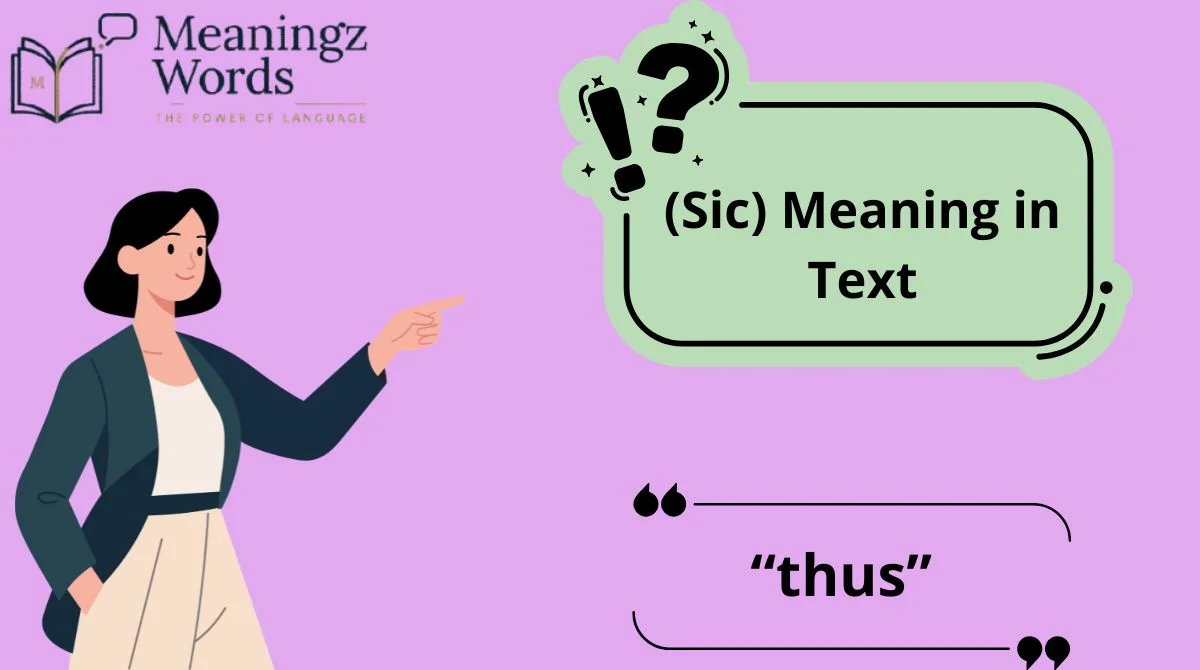
“Sic” means that the word, spelling, grammar, or information appearing before it is exactly how it was written in the original source, even if it looks incorrect.
People usually see it in books, journalism, academic writing, legal documents, screenshots, and online discussions.
Understanding it helps you know whether a mistake belongs to the original writer or the person quoting them.
Quick Answer Box
| Information | Answer |
|---|---|
| Meaning | Indicates that a quoted mistake or unusual wording appears exactly in the original text |
| Full Form | No full form (it is a Latin word) |
| Pronunciation | “Sik” (like “sick”) |
| Category | Writing term / editorial notation |
| Tone | Neutral, sometimes critical or humorous depending on context |
| Used On | Articles, books, research papers, legal writing, social media, screenshots, quotes |
| Difficulty Level | Beginner |
| One-line definition | “(Sic)” tells readers: “This is exactly what the original person wrote.” |
What Does (Sic) Mean in Text?
(Sic) is a Latin word meaning “thus” or “so.” In modern writing, it is used inside brackets after a quoted word or phrase to show that the writer has copied the original text exactly.
It tells the reader:
“This unusual spelling, grammar mistake, or strange wording was already there in the original.”
The person using (sic) is not correcting the mistake. They are showing that they noticed it and intentionally kept it.
Example:
Original message:
“I definately [sic] want to join.”
A writer quoting it may write:
The person said, “I definately [sic] want to join.”
The [sic] shows that “definately” was misspelled in the original message. The person quoting it did not make the mistake.
Where Did (Sic) Come From?
The word sic comes from the Latin phrase “sic erat scriptum,” which means “thus it was written.”
Historically, scholars and editors used it when copying old manuscripts or documents. If a text contained an unusual spelling or error, adding (sic) helped preserve the original wording without silently changing it.
Today, it is common in:
- Journalism
- Academic research
- Historical documents
- Court records
- Interviews
- Public statements
- Online discussions
Why Do People Use (Sic)?
People use (sic) for several reasons:
1. To Show an Original Error
The most common use is to highlight a mistake in a quote.
Example:
The advertisement promised “free gifts for every costumer [sic].”
Here, costumer is incorrect because it should likely be customer. The writer keeps the original spelling and adds [sic].
2. To Avoid Changing Someone’s Words
Sometimes a quote must remain exactly as it was written.
This matters in:
- Legal documents
- Academic research
- Historical records
- News reporting
Changing the wording could make the quote less accurate.
3. To Add Context or Humor
Online, people sometimes use (sic) in a playful or sarcastic way.
Example:
“I am the best driver in the world [sic].”
The writer may be pointing out that the statement itself seems questionable.
How Is (Sic) Used in Different Places?
(Sic) in Articles and Journalism
Journalists use (sic) when quoting public statements that contain errors.
Example:
The official statement said the project was “completly [sic] finished.”
The journalist is showing that the spelling mistake came from the official statement.
(Sic) in Academic Writing
Students and researchers use (sic) when quoting sources exactly.
Example:
The study described the results as “highly significent [sic].”
This shows the researcher did not accidentally introduce the spelling mistake.
(Sic) in Social Media
On platforms like Instagram, Facebook, TikTok, Reddit, and Discord, users sometimes add (sic) when sharing screenshots or comments.
Example:
“Your going to love this movie [sic].”
The writer is pointing out the incorrect use of your instead of you’re.
However, online use can sometimes feel mocking or rude.
Is (Sic) Rude?
It depends on the situation.
In formal writing, (sic) is usually neutral. It simply provides accuracy.
In casual conversations, adding (sic) can sound:
- Corrective
- Sarcastic
- Judgmental
- Like you are making fun of someone’s mistake
Example:
“I seen that movie yesterday [sic].”
In an academic paper, this may be acceptable.
In a personal chat, it may come across as unnecessary criticism.
Is (Sic) Offensive?
No, (sic) itself is not offensive.
However, the intention behind using it matters.
Using it to preserve an important quote is normal.
Using it repeatedly to embarrass someone’s spelling or grammar may appear disrespectful.
Does (Sic) Mean “Wrong”?
Not always.
A word followed by (sic) may be:
- A spelling mistake
- Incorrect grammar
- An unusual phrase
- An outdated spelling
- A dialect difference
- A surprising statement
Sometimes the original wording is not wrong; it is simply unusual.
Example:
The letter was written in “colour [sic].”
In American English writing, someone might add (sic) after “colour,” but British English considers that spelling correct. Context matters.
How to Write (Sic) Correctly
The usual format is:
- [sic] inside square brackets
- Usually placed immediately after the unusual word or phrase
Correct:
“He definately [sic] agreed.”
Less common:
“He definately (sic) agreed.”
Many editors prefer [sic] because brackets show that the note was added by the person quoting.
Real-Life Conversation Examples
Example 1: Text Message
Original:
“I will be their at 5.”
Quoted:
My friend texted, “I will be their [sic] at 5.”
Explanation:
“Their” is likely a mistake for “there.” The quote keeps the original message.
Example 2: News Quote
Original statement:
“We have recieved many complaints.”
Article:
The company said it had “recieved [sic] many complaints.”
Explanation:
The journalist shows the spelling error came from the company’s statement.
Example 3: Online Comment
Comment:
“Your wrong about this.”
Reply:
“Your wrong [sic] about this.”
Explanation:
The person is pointing out the grammar mistake. Depending on tone, this may sound sarcastic.
Common Mistakes About (Sic)
Mistake 1: Thinking Sic Is an Acronym
Many people think SIC stands for something.
It does not.
It is a Latin word.
Mistake 2: Using (Sic) to Correct Someone
The purpose of (sic) is not to fix errors.
It shows the original wording.
Mistake 3: Adding It Everywhere
Not every typo needs (sic).
Use it when the exact wording matters.
For casual writing, simply correcting the mistake is usually better.
(Sic) vs Similar Writing Terms
| Term | Meaning | Example |
|---|---|---|
| [sic] | Original wording contains an error or unusual phrase | “definately [sic]” |
| [edited] | Text has been changed | “[edited for clarity]” |
| [emphasis added] | Someone added bold or italics for attention | “[emphasis added]” |
| … (ellipsis) | Shows missing words | “The report stated…” |
| [brackets] | Added information from the writer | “He [the manager] replied” |
How to Reply When Someone Uses (Sic)
If someone uses (sic) in a discussion, the best response depends on the situation.
If they are correcting a mistake:
You can simply say:
“Thanks for pointing that out.”
If they are being sarcastic:
You can ignore it or focus on the main discussion.
If you want clarification:
You can ask:
“Are you referring to the spelling or the meaning?”
Frequently Asked Questions
What does (sic) mean on social media?
On social media, (sic) usually means the person copied a word or phrase exactly, including any mistake. It can be neutral or sarcastic depending on the context.
Is (sic) pronounced “sick”?
Yes. It is pronounced “sik,” like the English word sick.
Should I use [sic] after every spelling mistake?
No. Use it only when you need to show that the mistake appeared in the original source.
Why is sic written in brackets?
Brackets show that the note was added by the person quoting the text, not included in the original words.
Is sic still used today?
Yes. It remains common in journalism, research, legal writing, publishing, and online quoting.
What is the difference between sic and typo?
A typo is a mistake in writing.
[Sic] is a note telling readers that a typo or unusual wording was already present in the original text.
Final Thoughts
(Sic) means “this is exactly how it was written.” It helps writers preserve accurate quotes while making readers aware of mistakes, unusual wording, or unexpected phrases.
In formal writing, it is a useful accuracy tool. In casual online conversations, use it carefully because it can sometimes sound like criticism.
A simple rule: Use [sic] when preserving someone’s exact words matters. If accuracy is not important, correcting the mistake is usually clearer.

Noah Collins is a language writer and vocabulary researcher with a passion for making English easy to understand. As a contributor to MeaningzWords, he creates clear, accurate, and engaging content that helps readers expand their vocabulary, understand word meanings, and improve their communication skills with confidence.