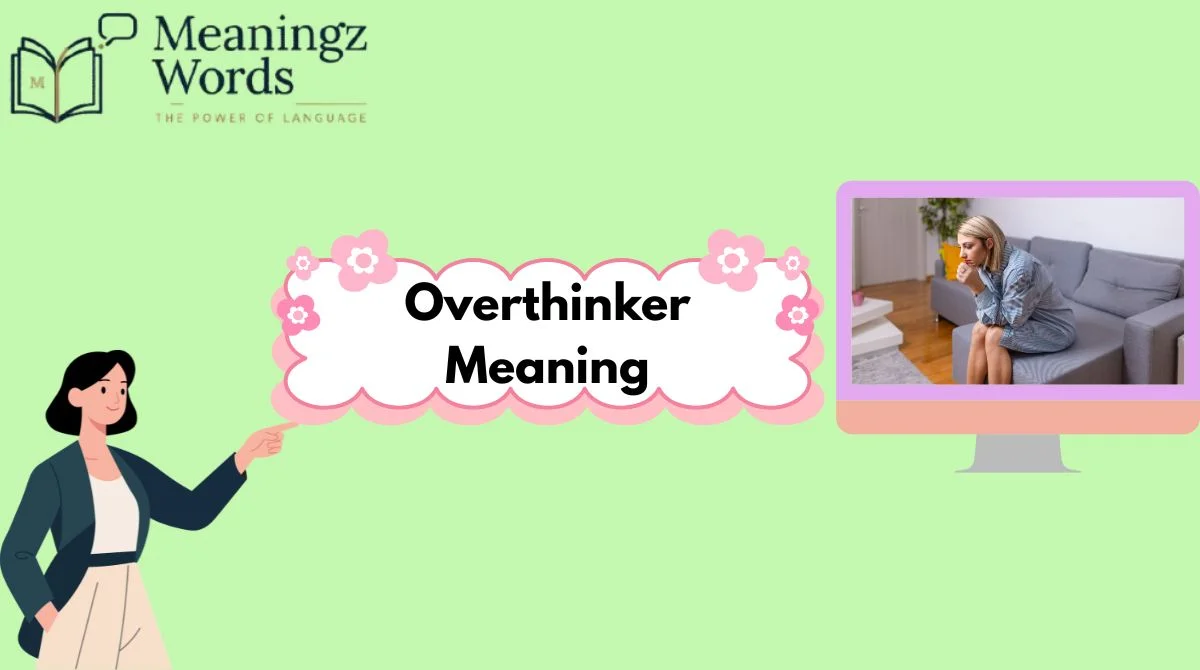
An overthinker is someone who spends too much time thinking about situations, decisions, conversations, or future events, often analyzing them more than necessary.
People search for the meaning of overthinker because they see it on social media, hear it in conversations, or wonder if the word describes their own habits.
Understanding the term helps you recognize when careful thinking becomes excessive and may affect daily life.
Quick Answer Box
| Topic | Answer |
|---|---|
| Meaning | A person who thinks about things excessively, often worrying or analyzing too much. |
| Full Form | None (not an abbreviation) |
| Pronunciation | OH-ver-think-er |
| Category | English word / Personality description |
| Tone | Usually neutral, sometimes humorous or sympathetic |
| Used On | Everyday conversations, TikTok, Instagram, WhatsApp, Facebook, X (Twitter), Reddit, blogs, podcasts |
| Difficulty Level | Easy |
| One-Line Definition | An overthinker is someone who repeatedly analyzes thoughts, situations, or decisions more than necessary. |
What Does Overthinker Mean?
An overthinker is a person who spends excessive time thinking about problems, conversations, decisions, or possible outcomes.
Instead of making a decision and moving on, an overthinker may:
- Replay past conversations repeatedly.
- Worry about future events.
- Imagine worst-case scenarios.
- Analyze small details for hours.
- Struggle to make simple decisions.
Everyone overthinks occasionally. Being called an overthinker usually means someone does it more often than most people.
What Is the Difference Between Thinking and Overthinking?
Thinking helps you solve problems.
Overthinking often keeps you stuck.
| Thinking | Overthinking |
|---|---|
| Helps solve problems | Creates more worries |
| Leads to decisions | Delays decisions |
| Focuses on facts | Focuses on “what if” questions |
| Usually ends quickly | Can continue for hours or days |
| Builds confidence | Often increases stress |
Healthy thinking is productive.
Overthinking is repetitive and often unhelpful.
Why Do People Use the Word “Overthinker”?
The word is commonly used to describe someone who:
- Worries too much.
- Analyzes everything.
- Needs reassurance.
- Finds it difficult to stop thinking.
- Second-guesses decisions.
Sometimes people use it jokingly.
Example:
“Don’t mind me. I’m just an overthinker.”
This means the speaker knows they tend to analyze things more than necessary.
Where Is “Overthinker” Commonly Used?
The term appears in many online and offline conversations.
Social Media
People often post captions like:
- “Only an overthinker would notice this.”
- “Being an overthinker is exhausting.”
- “Dear fellow overthinkers, you’re not alone.”
These posts usually express relatable experiences.
Someone may send:
“Sorry for asking again. I’m an overthinker.”
They are explaining why they keep checking or worrying.
Users often include the word in bios or captions to describe their personality.
Example:
“Coffee lover ☕ | Overthinker | Dreamer”
TikTok
Videos often discuss:
- Relationship overthinking
- Anxiety
- Funny overthinking moments
- Daily struggles
Gaming
Gamers sometimes joke:
“I’m overthinking every move.”
Here, it simply means analyzing strategies too much.
School and College
Students may say:
“I overthought the exam questions.”
Meaning they made simple questions harder by analyzing too much.
Workplace
Employees sometimes say:
“I think I’m overthinking this email.”
This means they’re spending too much time trying to make it perfect.
Is Being an Overthinker Always Bad?
No.
Overthinking and careful thinking are not the same.
Many overthinkers are:
- Detail-oriented.
- Creative.
- Thoughtful.
- Good planners.
- Careful decision-makers.
However, excessive overthinking can:
- Increase stress.
- Reduce confidence.
- Delay decisions.
- Make simple problems seem larger.
Balance is important.
Signs Someone May Be an Overthinker
Common signs include:
- Replaying conversations after they end.
- Constantly wondering what others think.
- Imagining many negative outcomes.
- Asking for reassurance repeatedly.
- Difficulty making choices.
- Feeling mentally tired from thinking.
These habits don’t automatically mean someone has a mental health condition. They simply describe common patterns of excessive thinking.
Examples of “Overthinker” in Everyday Conversations
Example 1
Emma: Did I sound rude in my message?
Lily: No, you’re just overthinking it.
Meaning: Emma is worrying unnecessarily.
Example 2
Jake: I’ve changed my email five times.
Alex: Stop being such an overthinker.
Meaning: Jake is spending too much time trying to make the email perfect.
Example 3
Sara: What if everyone noticed my mistake?
Mia: You’re overthinking it. Most people probably didn’t notice.
Meaning: Sara is imagining a bigger problem than actually exists.
Example 4
Ryan: I can’t decide which laptop to buy.
Chris: You’ve compared them for two weeks. You’re definitely an overthinker.
Meaning: Ryan is delaying a decision by analyzing every detail.
Does “Overthinker” Have Different Meanings?
The core meaning stays the same.
However, the context changes.
| Context | Meaning |
|---|---|
| Relationships | Thinking too much about texts, feelings, or mixed signals |
| School | Worrying excessively about grades or assignments |
| Work | Analyzing tasks or emails too much |
| Social Media | Describing a personality trait, often humorously |
| Gaming | Thinking too much before making a move |
Is Calling Someone an Overthinker an Insult?
Usually, no.
The word is generally neutral.
It can even be affectionate.
Example:
“I know you’re an overthinker, so I wanted to reassure you.”
However, tone matters.
If said sarcastically, it may sound dismissive.
Can Someone Be an Overthinker Without Having Anxiety?
Yes.
Overthinking and anxiety are related but not identical.
Someone can overthink because they:
- Want everything to be perfect.
- Care deeply about outcomes.
- Like analyzing situations.
- Fear making mistakes.
Only a qualified healthcare professional can diagnose an anxiety disorder.
Overthinker vs Worrier vs Deep Thinker
| Term | Meaning |
|---|---|
| Overthinker | Thinks about situations more than necessary |
| Worrier | Focuses mainly on possible problems |
| Deep Thinker | Enjoys thoughtful analysis and complex ideas |
| Critical Thinker | Uses logic and evidence to solve problems |
A deep thinker analyzes ideas.
An overthinker often analyzes worries.
Common Misunderstandings About Overthinkers
Myth: Overthinkers are intelligent because they think more.
Reality: Thinking more doesn’t always lead to better decisions.
Myth: Overthinking always means anxiety.
Reality: Many people overthink without having an anxiety disorder.
Myth: Overthinkers are weak.
Reality: Anyone can become an overthinker during stressful periods.
Similar Words and Related Expressions
Some words with similar meanings include:
- Excessive thinker
- Chronic worrier
- Analyzer
- Overanalyzer
- Ruminator
- Perfectionist (in some situations)
- Second-guesser
These words aren’t perfect synonyms, but they share related ideas.
Opposite of Overthinker
Possible opposites include:
- Decisive person
- Easygoing person
- Go-with-the-flow person
- Spontaneous person
- Quick decision-maker
The exact opposite depends on the situation.
How to Respond When Someone Says, “I’m an Overthinker”
A kind response could be:
- “I understand.”
- “You’re not alone.”
- “Let’s focus on the facts.”
- “Take your time.”
- “It’ll probably be okay.”
Avoid dismissing their feelings with comments like:
- “Just stop thinking.”
- “You’re being dramatic.”
Supportive responses are usually more helpful.
Frequently Asked Questions
Is “overthinker” a real English word?
Yes. It is a commonly used English noun formed from the verb overthink, which means to think about something too much.
What does “I’m an overthinker” mean?
It means the speaker believes they spend too much time analyzing situations, decisions, or conversations.
Is being an overthinker a personality trait?
It can describe a person’s typical behavior, but it is not an official personality type.
Is overthinking always negative?
No. Careful thinking can be helpful. It becomes overthinking when it prevents action or causes unnecessary stress.
Can overthinking affect relationships?
Yes. Constantly analyzing messages, conversations, or intentions can sometimes create misunderstandings or unnecessary worry.
Why is “overthinker” popular on social media?
Many people relate to the experience of replaying conversations, worrying about small details, or imagining different outcomes. Social media users often share memes, videos, and posts about these experiences.
Conclusion
An overthinker is someone who thinks about situations more than necessary, often analyzing details, replaying events, or worrying about possible outcomes.
The word is widely used in everyday conversations and across social media to describe a common habit rather than a medical diagnosis.
While careful thinking can be a strength, excessive thinking may lead to stress and indecision.
If you recognize this habit in yourself, try focusing on facts, setting time limits for decisions, and remembering that not every situation needs endless analysis.

Noah Collins is a language writer and vocabulary researcher with a passion for making English easy to understand. As a contributor to MeaningzWords, he creates clear, accurate, and engaging content that helps readers expand their vocabulary, understand word meanings, and improve their communication skills with confidence.