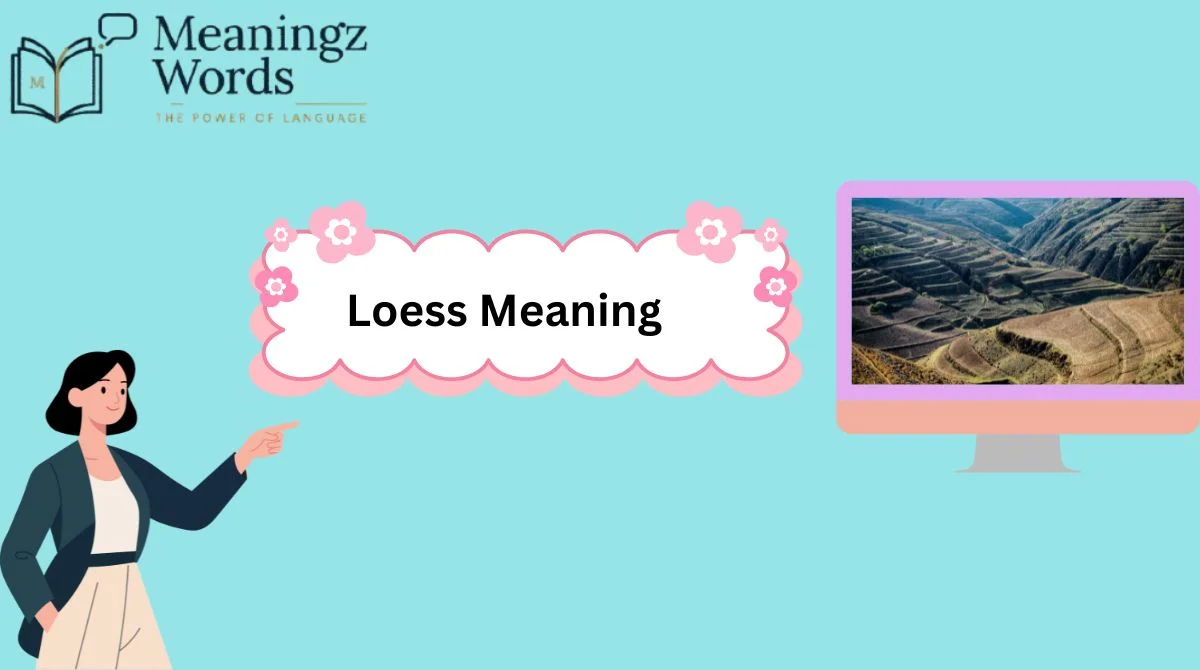
Loess meaning refers to a type of fine, wind-deposited sediment made mostly of silt particles that forms fertile soils in many parts of the world.
People usually search this term when studying geography, geology, agriculture, or environmental science.
Understanding loess helps explain how landscapes form, why some regions have highly productive farmland, and how wind shapes the Earth’s surface.
Quick Answer Box
| Category | Answer |
|---|---|
| Meaning | A fine-grained sediment deposit made mainly of silt, carried and deposited by wind |
| Full Form | No full form (loess is a geological term) |
| Pronunciation | “LUSS” (rhymes with “bus”) |
| Category | Geography, Geology, Soil Science |
| Tone | Scientific / Academic |
| Used In | Geography, geology, agriculture, environmental studies |
| Difficulty Level | Intermediate |
| One-Line Definition | Loess is a wind-blown layer of fine sediment that often creates very fertile soil. |
What Does Loess Mean?
Loess is a loose, powdery deposit of fine sediment that is mainly made up of silt. It forms when strong winds pick up tiny soil particles from places like deserts, river valleys, and areas affected by glaciers, then carry and settle them somewhere else.
Unlike sand, which has larger grains, loess particles are extremely small. These fine particles can create deep, nutrient-rich soils that support farming.
In simple words:
Loess is dust carried by wind that builds layers of fertile soil over time.
Loess Definition in Geography and Geology
In geography, loess refers to wind-deposited sediment layers found across large areas of land.
Geologists classify loess as an aeolian deposit, meaning it was transported and deposited by wind.
Key characteristics of loess include:
- Made mostly of silt-sized particles
- Usually light brown, yellowish, or gray in color
- Forms thick layers over thousands of years
- Often creates highly productive agricultural land
- Can easily erode when exposed to water or strong weather
Origin of the Word Loess
The word loess comes from the German word “Löss,” which was used to describe these soft, dusty deposits found in parts of Europe.
The term became popular in geology because many important loess formations were studied in regions such as Germany, where scientists examined their role in soil formation and landscapes.
How Does Loess Form?
Loess forms through a long natural process involving wind, climate, and sediment movement.
Wind Transport
During dry periods, tiny particles of dust become loose and are lifted by strong winds.
These particles can travel hundreds or even thousands of kilometers.
Sediment Deposition
When wind speed decreases, the particles settle on the ground and create layers of loess.
Over time, repeated deposits build thick formations.
Soil Development
Plants, weather, and natural processes transform these deposits into rich soils that can support agriculture.
Where Is Loess Found?
Loess deposits exist on almost every continent except Antarctica.
Some famous loess regions include:
- Central China’s Loess Plateau
- The Great Plains of North America
- Parts of Europe
- Argentina’s Pampas region
- Areas near former glaciers
The Loess Plateau in China is one of the largest and most well-known loess regions in the world.
Why Is Loess Important?
Loess has major importance in farming, geography, and environmental studies.
Supports Agriculture
Loess soils are often highly fertile because they contain minerals and nutrients needed for plant growth.
Many agricultural regions depend on loess-based soils for crops such as:
- Wheat
- Corn
- Vegetables
- Fruits
Helps Scientists Study Climate History
Layers of loess can preserve information about past climates.
Scientists study these deposits to understand:
- Ancient wind patterns
- Ice ages
- Environmental changes
Shapes Landscapes
Loess affects how landforms develop.
It can create:
- Hills
- Cliffs
- Valleys
- Plateaus
Is Loess Soil Good for Farming?
Yes, loess soil is generally considered excellent for farming.
Its advantages include:
- Good drainage
- High mineral content
- Easy cultivation
- Ability to hold enough moisture
However, loess can also have problems.
The biggest issue is erosion.
Because loess particles are very loose, heavy rain or strong winds can remove the soil quickly.
Loess vs Other Soil Types
| Feature | Loess | Clay Soil | Sand Soil |
|---|---|---|---|
| Main Material | Fine silt particles | Very small clay particles | Large sand particles |
| Formation | Wind deposits | Weathering of rocks | Rock breakdown |
| Fertility | Usually high | Depends on minerals | Usually lower |
| Drainage | Moderate | Poor | Excellent |
| Erosion Risk | High | Medium | Medium |
Real-Life Examples of Loess
Example 1: Farming Areas
A farmer may grow crops successfully in a region covered with loess because the soil contains valuable minerals.
Explanation:
The wind-deposited sediment creates a nutrient-rich environment for plants.
Example 2: Geography Studies
A geography student may learn about the Loess Plateau in China.
Explanation:
The region shows how wind-created deposits can influence human settlement, agriculture, and erosion problems.
Example 3: Climate Research
A scientist may analyze layers of loess to study ancient weather conditions.
Explanation:
Different layers can reveal changes in climate over thousands of years.
Common Questions About Loess
What is loess in simple words?
Loess is a layer of fine dust-like soil material that was carried and deposited by wind.
Is loess a type of soil?
Loess itself is a sediment deposit, but over time it can develop into fertile soil.
Is loess dangerous?
Loess is not dangerous by itself. However, areas with thick loess deposits can experience erosion, landslides, or unstable slopes if poorly managed.
Why is loess fertile?
Loess contains minerals and nutrients that plants need. Its fine structure also allows roots to grow easily.
What is the difference between loess and sand?
Loess contains very fine silt particles, while sand has much larger grains. Loess is usually more fertile and holds more nutrients.
Common Misunderstandings About Loess
Myth: Loess is just ordinary dust
Reality:
Loess may look like dust, but it is a geological deposit with specific particle sizes and formation processes.
Myth: All loose soil is loess
Reality:
Not every loose soil deposit is loess. True loess is mainly wind-deposited silt.
Myth: Loess only exists in deserts
Reality:
Loess can form far away from deserts, including areas influenced by glaciers and rivers.
Related Terms to Loess
Some related geography and geology terms include:
- Aeolian deposits – Materials transported by wind
- Sediment – Natural material deposited by water, wind, or ice
- Silt – Fine mineral particles smaller than sand
- Soil erosion – Removal of soil by wind or water
- Glacial deposits – Materials left behind by glaciers
FAQs
What does loess mean?
Loess means a fine layer of wind-blown sediment made mostly of silt particles.
How do you pronounce loess?
Loess is pronounced “luss.”
Is loess natural?
Yes. Loess forms naturally through wind movement and sediment deposition.
Why do scientists study loess?
Scientists study loess to understand soil formation, climate history, and environmental changes.
Can plants grow in loess soil?
Yes. Many plants grow well in loess because it is often rich in minerals and nutrients.
Conclusion
The meaning of loess is a wind-deposited layer of fine sediment, mainly made of silt, that can create some of the world’s most fertile soils.
It plays an important role in agriculture, landscape formation, and climate research.
If you encounter the term loess in geography or science, remember this simple idea: loess is ancient wind-carried dust that became valuable soil over time.

Noah Collins is a language writer and vocabulary researcher with a passion for making English easy to understand. As a contributor to MeaningzWords, he creates clear, accurate, and engaging content that helps readers expand their vocabulary, understand word meanings, and improve their communication skills with confidence.


