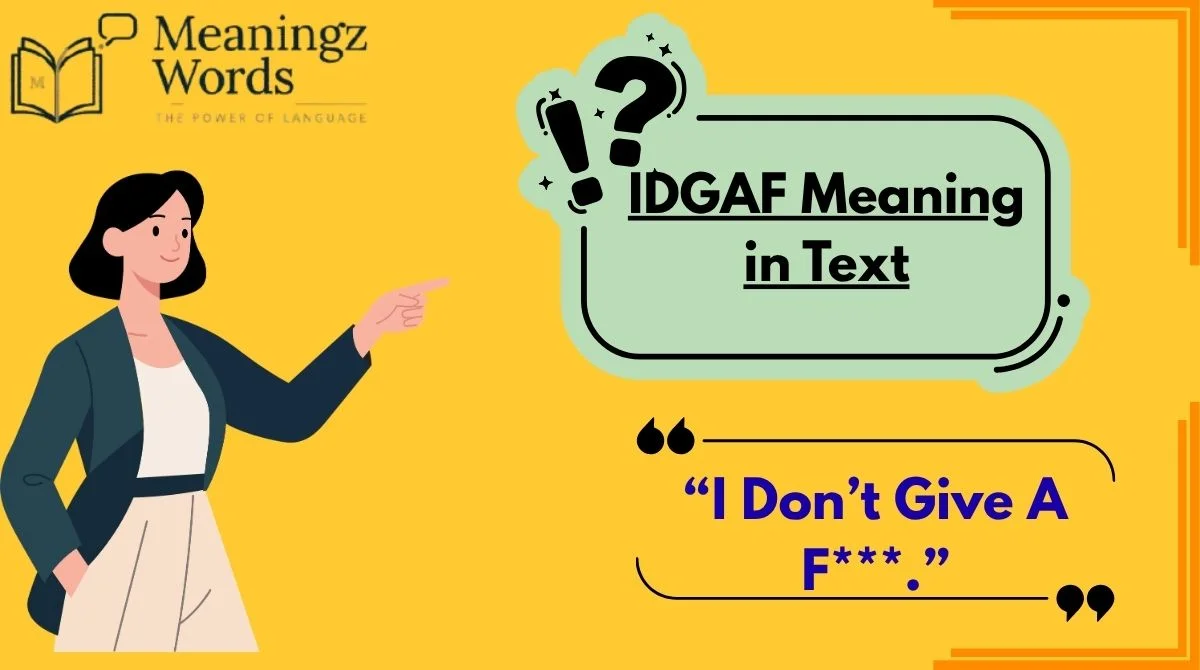
If you’ve seen IDGAF in a text message, TikTok comment, Snapchat chat, or gaming conversation, it usually means “I Don’t Give A F***.”
It’s a strong slang expression used when someone wants to show they don’t care about a situation, opinion, or outcome.
People search for this phrase because it appears frequently in social media posts, memes, and casual conversations, and the tone can range from playful to very rude depending on context.
Quick Answer
Most Common Meaning
Meaning
I don’t care / I’m not bothered
Full Form
I Don’t Give A F***
Pronunciation
Eye-dee-gee-ay-eff
Category
Internet slang
Tone
Casual, blunt, sometimes rude
Used On
Texting, TikTok, Snapchat, Instagram, Discord
Difficulty Level
Easy
One-line definition
IDGAF is a slang abbreviation that means someone does not care about something and wants others to know it.
What does IDGAF mean in a text?
In texting, IDGAF means “I Don’t Give A F***.” It’s a stronger version of saying “I don’t care.”
People use it when they want to:
- Show they’re not worried
- Dismiss criticism
- Express frustration
- Act confident or unbothered
- End an argument
Example
Text conversation
Person A
People are talking about your post.
Person B
IDGAF. Let them talk.
Meaning: Person B is saying they do not care what others are saying.
Why do people use IDGAF?
It’s popular because it’s short, emotional, and direct. A four-letter abbreviation feels faster and less formal than writing a full sentence.
Common reasons:
| Reason | Example |
|---|---|
| Confidence | “IDGAF what they think.” |
| Anger | “Honestly, IDGAF anymore.” |
| Humor | “IDGAF, I’m eating the last slice.” |
| Rebellion | “IDGAF about the rules.” |
| Stress relief | “At this point, IDGAF.” |
Where is IDGAF commonly used?
TikTok
Very common
Often appears in captions and comments:
“Me wearing pajamas to the store because IDGAF.”
Usually meant humorously or confidently.
Snapchat
Common
Used in private chats and stories:
“Everyone skipped class. IDGAF.”
Common
Appears in captions, reels, and comments:
“New haircut and IDGAF if anyone likes it.”
Gaming & Discord
Common
Gamers may use it after a loss or risky move:
“Rush mid. IDGAF.”
Professional messaging
Avoid
This is not appropriate for work emails, business chats, or communication with teachers, clients, or supervisors.
Is IDGAF rude?
Usually yes, at least somewhat.
Because it contains a profanity, many people see it as:
- Rude
- Aggressive
- Disrespectful
- Very casual
The same message can sound very different depending on who receives it.
| Message | Tone |
|---|---|
| “I don’t care.” | Neutral |
| “IDC.” | Casual |
| “IDGAF.” | Strong / blunt |
| “I don’t give a f***.” | Very strong |
Is IDGAF offensive?
It can be. Friends may use it jokingly, but some people find the profanity offensive, especially:
- Parents
- Teachers
- Older relatives
- Managers
- Professional contacts
Is IDGAF flirty?
Not by itself.
However, it can appear in a flirty context:
Example
Flirty context
Person A
Everyone says we’d make a good couple.
Person B
IDGAF what they say… I agree.
Here, the flirtation comes from the second part of the sentence, not from IDGAF itself.
Real-life conversation examples
Example 1: Ignoring criticism
Common use
Friend
People didn’t like your video.
You
IDGAF. I had fun making it.
Meaning: You care more about enjoying the activity than about others’ opinions.
Example 2: Stress
Common use
Coworker
Did you see the office drama?
You
At this point, IDGAF.
Meaning: You’re tired of the situation and no longer want to worry about it.
Example 3: Humor
Joking
Friend
You already had two desserts.
You
IDGAF, I’m getting a third.
Meaning: You’re jokingly saying you don’t care about the consequence.
How to reply to IDGAF
Your reply depends on the tone.
| If they mean… | You could reply… |
|---|---|
| Joking | “Fair enough 😂” |
| Confidence | “Do what makes you happy.” |
| Anger | “Sounds like you’re frustrated.” |
| Ending an argument | “Okay, let’s move on.” |
| Being rude | “No need to be harsh.” |
IDGAF vs similar slang
| Slang | Meaning |
|---|---|
| IDC | I don’t care |
| IDGAF | I don’t give a f*** |
| SMH | Shaking my head |
| FML | F*** my life |
| YOLO | You only live once |
Which is stronger: IDC or IDGAF?
| Expression | Strength |
|---|---|
| IDC | Mild |
| IDGAF | Strong |
| “I don’t give a f***” | Very strong |
Common mistakes people make
1. Using it at work
Avoid:
“IDGAF about the deadline.”
That can seriously damage professional relationships.
2. Assuming it’s always angry
Many people use it jokingly or dramatically, especially online.
3. Using it with people who dislike profanity
Some readers focus on the swear word more than the message.
When should you avoid using IDGAF?
Avoid in these situations
- Job interviews
- Work emails
- School assignments
- Messages to teachers
- Customer service conversations
- Formal business communication
- Talking to someone you don’t know well
Safer alternatives
| Instead of | Use |
|---|---|
| IDGAF | “I’m not concerned.” |
| IDGAF | “I don’t mind.” |
| IDGAF | “I’m okay either way.” |
| IDGAF | “It doesn’t bother me.” |
| IDGAF | “I’m not worried about it.” |
Frequently asked questions
What does IDGAF mean from a girl?
Usually the same thing it means from anyone else: “I don’t care” or “I’m not bothered.” The tone depends on the conversation.
What does IDGAF mean from a guy?
Again, it usually means “I don’t care” or “I’m not bothered.” Context matters more than gender.
What does IDGAF mean on Snapchat?
On Snapchat it almost always means “I don’t give a f***” and is used casually in chats or stories.
What does IDGAF mean on TikTok?
On TikTok it often expresses confidence, humor, or being “unbothered.”
Is IDGAF the same as IDC?
No. IDC is a milder way to say “I don’t care.” IDGAF is much stronger and includes profanity.
Can IDGAF be positive?
Yes. Someone might use it to show confidence, such as “I’m going after my goals and IDGAF what people think.”
The bottom line
IDGAF is one of the internet’s most common slang abbreviations. In texts, Snapchat messages, TikTok comments, and gaming chats, it almost always means “I Don’t Give A F***.”
The key thing to remember is tone. It can sound funny, confident, frustrated, or rude depending on the situation.
Use it with friends who are comfortable with casual slang, but avoid it in professional, academic, or formal conversations.
If you’re unsure whether it’s appropriate, a safer alternative like “I don’t mind” or “I’m not worried about it” will usually get the same point across without the profanity.

Noah Collins is a language writer and vocabulary researcher with a passion for making English easy to understand. As a contributor to MeaningzWords, he creates clear, accurate, and engaging content that helps readers expand their vocabulary, understand word meanings, and improve their communication skills with confidence.